The Wolf Of Kisimul Castle Free Download UPDATED
The Wolf Of Kisimul Castle Free Download

The Hebrides (; Scottish Gaelic: Innse Gall, pronounced [ˈĩːʃə ˈkaul̪ˠ]; Quondam Norse: Suðreyjar, "southern isles") are a Scottish archipelago off the w coast of the Scottish mainland. The islands autumn into two main groups, based on their proximity to the mainland: the Inner and Outer Hebrides.
These islands take a long history of occupation (dating dorsum to the Mesolithic menstruum), and the culture of the inhabitants has been successively influenced by the cultures of Celtic-speaking, Norse-speaking, and English-speaking peoples. This diversity is reflected in the various names given to the islands, which are derived from the dissimilar languages that take been spoken at that place at various points in their history.
The Hebrides are where much of Scottish Gaelic literature and Gaelic music has historically originated. Today, the economic system of the islands is dependent on crofting, fishing, tourism, the oil industry, and renewable energy. The Hebrides accept less biodiversity than mainland Scotland, but a significant number of seals and seabirds.
The islands take a combined area of approximately 7,200 square kilometres (2,800 sq mi), and, as of 2011[update], a combined population of around 45,000.[1]
Geology, geography and climate [edit]

The Hebrides accept a diverse geology, ranging in age from Precambrian strata that are among the oldest rocks in Europe, to Paleogene igneous intrusions.[2] [3] [Annotation 1] Raised shore platforms in the Hebrides have been identified as strandflats, possibly formed during the Pliocene period and later on modified by the Quaternary glaciations.[4]
The Hebrides can be divided into two chief groups, separated from one another by the Minch to the north and the Bounding main of the Hebrides to the south. The Inner Hebrides lie closer to mainland Scotland and include Islay, Jura, Skye, Mull, Raasay, Staffa and the Pocket-sized Isles. There are 36 inhabited islands in this group. The Outer Hebrides course a chain of more than than 100 islands and small skerries located about lxx kilometres (45 mi) westward of mainland Scotland. Amongst them, fifteen are inhabited. The main inhabited islands include Lewis and Harris, Due north Uist, Benbecula, S Uist, and Barra.
A complication is that there are diverse descriptions of the scope of the Hebrides. The Collins Encyclopedia of Scotland describes the Inner Hebrides as lying "due east of the Minch". This definition would comprehend all offshore islands, including those that lie in the sea lochs, such as Eilean Bàn and Eilean Donan , which might not usually exist described every bit "Hebridean". However, no formal definition exists.[five] [half-dozen]
In the past, the Outer Hebrides were often referred to equally the Long Island (Scottish Gaelic: An t-Eilean Fada). Today, they are likewise sometimes known equally the Western Isles, although this phrase tin can besides exist used to refer to the Hebrides in general.[Note two]
The Hebrides have a absurd, temperate climate that is remarkably mild and steady for such a northerly latitude, due to the influence of the Gulf Stream. In the Outer Hebrides, the average temperature is half dozen °C (44 °F) in January and fourteen °C (57 °F) in the summer. The average annual rainfall in Lewis is one,100 millimetres (43 in), and there are between 1,100 and 1,200 hours of sunshine per annum (13%). The summertime days are relatively long, and May through August is the driest period.[viii]
Etymology [edit]
The earliest surviving written references to the islands were made circa 77 AD past Pliny the Elder in his Natural History: He states that in that location are 30 Hebudes , and makes a carve up reference to Dumna , which Watson (1926) concluded refers unequivocally to the Outer Hebrides. About lxxx years subsequently Pliny the Elder, in 140–150 Advertizing, Ptolemy (drawing on accounts of the naval expeditions of Agricola ) writes that there are five Ebudes (possibly meaning the Inner Hebrides) and Dumna .[9] [10] [11] Later texts in classical Latin, by writers such as Solinus , use the forms Hebudes and Hæbudes .[12]
The name Ebudes (used by Ptolemy) may be pre-Celtic.[xi] Ptolemy calls Islay " Epidion ",[thirteen] and the use of the letter of the alphabet "p" suggests a Brythonic or Pictish tribal proper noun, Epidii ,[xiv] because the root is not Gaelic.[15] Woolf (2012) has suggested that Ebudes may be "an Irish gaelic attempt to reproduce the give-and-take Epidii phonetically, rather than past translating it", and that the tribe's name may come from the root epos , meaning "equus caballus".[sixteen] Watson (1926) also notes a possible relationship between Ebudes , and the aboriginal Irish Ulaid tribal proper noun Ibdaig , and also the personal proper name of a king Iubdán (recorded in the Silva Gadelica).[xi]

The names of other individual islands reflect their complex linguistic history. The majority are Norse or Gaelic, simply the roots of several other names for Hebrides islands may have a pre-Celtic origin.[11] Adomnán, a seventh-century abbot of Iona, records Colonsay every bit Colosus and Tiree every bit Ethica, and both of these may exist pre-Celtic names.[17] The etymology of Skye is complex and may also include a pre-Celtic root.[fifteen] Lewis is Ljoðhús in Old Norse. Various suggestions have been made equally to possible meanings of the proper name in Norse (for example, "song house"),[xviii] but the name is not of Gaelic origin, and the Norse provenance is questionable.[fifteen]
The earliest comprehensive written list of Hebridean island names was compiled past Donald Monro in 1549. This list too provides the earliest written reference to the names of some of the islands.
The derivations of all the inhabited islands of the Hebrides and some of the larger uninhabited ones are listed below.
Outer Hebrides [edit]
Lewis and Harris is the largest island in Scotland and the 3rd largest of the British Isles, after Smashing Britain and Republic of ireland.[19] It incorporates Lewis in the north and Harris in the south, both of which are oftentimes referred to as individual islands, although they are joined past a country border. The island does non take a single common name in either English language or Gaelic and is referred to as "Lewis and Harris", "Lewis with Harris", "Harris with Lewis" etc. For this reason it is treated as two divide islands beneath.[xx] The derivation of Lewis may exist pre-Celtic (run across in a higher place) and the origin of Harris is no less problematic. In the Ravenna Cosmography, Erimon may refer to Harris[21] (or perhaps the Outer Hebrides equally a whole). This give-and-take may derive from the Ancient Greek: ἐρῆμος ( erimos "desert".[22] The origin of Uist (One-time Norse: Ívist) is similarly unclear.[fifteen]
| Island | Derivation | Language | Meaning | Munro (1549) | Mod Gaelic name | Alternative Derivations |
|---|---|---|---|---|---|---|
| Baleshare | Am Baile Sear | Gaelic | eastward town[23] | Baile Sear | ||
| Barra | Barrøy | Norse | Finbar's island[24] | Barray | Barraigh | |
| Benbecula | Peighinn nam Fadhla | Gaelic | pennyland of the fords[25] | Beinn nam Fadhla | "little mountain of the ford" or "herdsman's mount"[23] | |
| Berneray | Bjarnarøy | Norse | Bjorn'southward island[25] | Beàrnaraigh | bear island[23] | |
| Eriskay | Uruisg | Gaelic | goblin island[23] | Eriskeray | Èirisgeigh | Erik'due south island[23] [26] |
| Flodaigh | Norse | float isle[27] | Flodaigh | |||
| Fraoch-eilean | Gaelic | heather island | Fraoch-eilean | |||
| Great Bernera | Bjarnarøy | Norse | Bjorn's island[28] | Berneray-Moir | Beàrnaraigh Mòr | bear isle[28] |
| Grimsay[Note 3] | Norse | Grim'due south island[23] | Griomasaigh | |||
| Grimsay[Note four] | Norse | Grim's island[23] | Griomasaigh | |||
| Harris | Erimon [21] | Ancient Greek? | desert | Harrey | na Hearadh | Ptolemy's Adru . In Quondam Norse (and in modern Icelandic), a Hérað is a type of administrative commune.[29] Alternatives are the Norse haerri , meaning "hills" and Gaelic na h-airdibh meaning "the heights".[28] |
| Lewis | Limnu | Pre-Celtic? | marshy | Lewis | Leòdhas | Ptolemy'south Limnu is literally "marshy". The Norse Ljoðhús may mean "song house" — see to a higher place.[15] [29] |
| Northward Uist | English/Pre-Celtic?[15] | Ywst | Uibhist a Tuath | "Uist" may possibly be "corn island"[30] or "west"[28] | ||
| Scalpay | Skalprøy | Norse | scallop island[28] | Scalpay of Harray | Sgalpaigh na Hearadh | |
| S Uist | English language/Pre-Celtic? | Uibhist a Deas | See N Uist | |||
| Vatersay | Norse | h2o island[31] | Wattersay | Bhatarsaigh | fathers' island, priest island, glove isle, wavy island[28] |
Inner Hebrides [edit]
At that place are diverse examples of earlier names for Inner Hebridean islands that were Gaelic, but these names have since been completely replaced. For example, Adomnán records Sainea, Elena, Ommon and Oideacha in the Inner Hebrides. These names presumably passed out of usage in the Norse era, and the locations of the islands they refer to are not clear.[32] As an example of the complexity: Rona may originally accept had a Celtic name, then later a similar-sounding Norse name, and and then still after a proper name that was essentially Gaelic again, but with a Norse "øy" or "ey" ending.[33] (See Rona, below.)
| Island | Derivation | Linguistic communication | Pregnant | Munro (1549) | Modern Gaelic name | Alternative Derivations |
|---|---|---|---|---|---|---|
| Canna | Cana | Gaelic | porpoise island[34] | Kannay | Eilean Chanaigh | Perhaps from Old Irish cana , meaning "wolf-whelp" or Norse kneøy - "knee island"[34] |
| Coll | Colosus | Pre-Celtic | Colla | Possibly from Gaelic coll - a hazel[35] | ||
| Colonsay | Pre-Celtic[36] | Colnansay | Colbhasa | Norse for "Columba'south isle"[37] | ||
| Danna | Norse | Unknown[38] | Danna | |||
| Easdale | Eisdcalfe | Eilean Èisdeal | Eas is "waterfall" in Gaelic and dale is the Norse for "valley".[39] However the combination seems inappropriate for this small island. Likewise known equally Ellenabeich - "island of the birches"[40] | |||
| Eigg | Eag | Gaelic | a notch[41] | Egga | Eige | Also chosen Eilean Nimban More - "island of the powerful women" until the 16th century.[42] |
| Eilean Bàn | Gaelic | white island | Naban | Eilean Bàn | ||
| Eilean dà Mhèinn | Gaelic | |||||
| Eilean Donan | Gaelic | isle of Donnán | Eilean Donnain | |||
| Eilean Shona | Norse | ocean island[43] | Eilean Seòna | Adomnán records the pre-Norse Gaelic name of Airthrago - the foreshore isle".[44] | ||
| Eilean Tioram | Gaelic | dry island | ||||
| Eriska | Norse | Erik's island[26] | Ùruisg | |||
| Erraid | Possibly Arthràigh | Gaelic | foreshore island[43] | Erray | Eilean Earraid | |
| Gigha | Guðey [45] | Norse | "good island" or "God island"[46] | Gigay | Giogha | Diverse including the Norse Gjáey - "isle of the geo" or "fissure", or "Gydha's island".[47] |
| Gometra | Goðrmaðrey [48] | Norse | "The skilful-man's island", or "God-man's island"[48] | Gòmastra | "Godmund's island".[49] | |
| Island of Ewe | Eubh | Gaelic | repeat | Ellan Ew | Eilean Iùbh | Old Irish gaelic: eo - "yew"[fifty] |
| Iona | Hí | Gaelic | Possibly "yew-place" | Colmkill | Ì Chaluim Chille | Numerous. Adomnán uses Ioua insula which became "Iona" through misreading.[51] |
| Islay | Pre-Celtic | Ila | Ìle | Various - see in a higher place | ||
| Jura | Dyrøy | Norse | deer island[52] | Duray | Diùra | Norse: Jurøy - udder island[52] |
| Kerrera | Kjarbarøy | Norse | Kjarbar'south island[53] | Cearrara | Norse: ciarrøy - "brushwood island"[53] or "trees island"[54] | |
| Lismore | Gaelic | large garden[55] | Lismoir | Lios Mòr | ||
| Luing | Gaelic | transport island[56] | Lunge | An t-Eilean Luinn | Norse: lyng - heather isle[56] or pre-Celtic[57] | |
| Lunga | Langrøy | Norse | longship island[58] | Lungay | Lunga | Gaelic long is also "ship"[58] |
| Muck | Eilean nam Muc | Gaelic | isle of pigs[59] | Swynes Ile | Eilean nam Muc | Eilean nam Muc-mhara - "whale isle". John of Fordun recorded it as Helantmok - "isle of swine".[59] |
| Mull | Malaios | Pre-Celtic[15] | Mull | Muile | Recorded by Ptolemy as Malaios [13] mayhap significant "lofty island".[11] In Norse times information technology became Mýl .[xv] | |
| Oronsay | Norse | ebb island[lx] | Ornansay | Orasaigh | Norse: "Oran'south island"[37] | |
| Raasay | Raasøy | Norse | roe deer island[61] | Raarsay | Ratharsair | Rossøy - "horse island"[61] |
| Rona | Hraunøy or Rònøy | Norse or Gaelic/Norse | "rough island" or "seal island" | Ronay | Rònaigh | |
| Rum | Pre-Celtic[62] | Ronin | Rùm | Various including Norse rõm-øy for "wide island" or Gaelic ì-dhruim - "isle of the ridge"[63] | ||
| Sanday | sandøy | Norse | sandy island[34] | Sandaigh | ||
| Scalpay | Skalprøy | Norse | scallop island[64] | Scalpay | Sgalpaigh | Norse: "transport island"[65] |
| Seil | Possibly Sal | Probably pre-Celtic[66] | "stream"[40] | Seill | Saoil | Gaelic: sealg - "hunting isle"[40] |
| Shuna | Unknown | Norse | Mayhap "sea island"[43] | Seunay | Siuna | Gaelic sidhean - "fairy"[67] |
| Skye | Scitis [68] | Pre-Celtic? | Perchance "winged island"[69] | Skye | An t-Eilean Sgitheanach | Numerous - see above |
| Soay | And so-øy | Norse | sheep island | Soa Urettil | Sòdhaigh | |
| Tanera Mor | Hawnarøy | Norse | island of the haven[70] | Hawrarymoir(?) | Tannara Mòr | Brythonic: Thanaros , the thunder god[70] |
| Tiree | Eth, Ethica | Possibly pre-Celtic | Unknown[17] | Tiriodh | Norse: Tirvist of unknown meaning and numerous Gaelic versions, some with a possible meaning of "land of corn"[17] | |
| Ulva | Ulvøy | Norse | wolf isle[71] | Ulbha | Ulfr'south island[71] |
Uninhabited islands [edit]

Dhu Heartach Lighthouse, During Structure by Sam Bender (1822–1878)
The names of uninhabited islands follow the same general patterns every bit the inhabited islands. (See the list, below, of the ten largest islands in the Hebrides and their outliers.)
The etymology of the proper name "St Kilda", a modest archipelago west of the Outer Hebrides, and the name of its principal island, "Hirta," is very complex. No saint is known past the proper name of Kilda, so various other theories have been proposed for the word's origin, which dates from the late 16th century.[72] Haswell-Smith (2004) notes that the full name "St Kilda" first appears on a Dutch map dated 1666, and that it may derive from the Norse phrase sunt kelda ("sweet wellwater") or from a mistaken Dutch assumption that the leap Tobar Childa was dedicated to a saint. ( Tobar Childa is a tautological placename, consisting of the Gaelic and Norse words for well, i.e., "well well").[73] Similarly unclear is the origin of the Gaelic for "Hirta", Hiort , Hirt , or Irt [74] a proper name for the island that long pre-dates the proper noun "St Kilda". Watson (1926) suggests that it may derive from the Sometime Irish gaelic word hirt ("death"), possibly a reference to the often lethally dangerous surrounding bounding main.[75] Maclean (1977) notes that an Icelandic saga near an early 13th-century voyage to Ireland refers to "the islands of Hirtir ", which means "stags" in Norse, and suggests that the outline of the isle of Hirta resembles the shape of a stag, speculating that therefore the proper noun "Hirta" may exist a reference to the island's shape.[76]
The etymology of the names of small islands may exist no less circuitous and elusive. In relation to Dubh Artach , Robert Louis Stevenson believed that "black and dismal" was one translation of the name, noting that "every bit usual, in Gaelic, it is non the merely one."[77]
| Island | Derivation | Language | Pregnant | Munro (1549) | Alternatives |
|---|---|---|---|---|---|
| Taransay | Norse | Taran's island[78] | Tarandsay | ||
| Scarba | Norse | cormorant isle[66] | Skarbay | ||
| Scarp | Skarpoe [79] | Norse | "barren"[66] or "stony" | Scarpe | |
| Pabbay | Norse | priest island[80] | Pabay | ||
| Hirta | Hirt | Possibly Former Irish | death | Hirta | Numerous - see above |
| Mingulay | Mikilay | Norse | large island[81] | Megaly | "Main loma island".[82] Murray (1973) states that the proper name "appropriately means Bird Island".[83] |
| Ronay | Norse | rough island[84] | |||
| Sandray | Sandray [85] | Norse | sand island[65] | Sanderay | |
| Wiay | Norse | Possibly "business firm island"[86] | |||
| Ceann Ear | Ceann Ear | Gaelic | east headland |
History [edit]
Prehistory [edit]
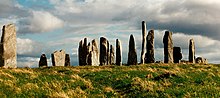
The Hebrides were settled during the Mesolithic era around 6500 BC or earlier, after the climatic conditions improved enough to sustain human settlement. Occupation at a site on Rùm is dated to 8590 ±95 uncorrected radiocarbon years BP, which is amongst the oldest testify of occupation in Scotland.[87] [88] At that place are many examples of structures from the Neolithic catamenia, the finest example beingness the standing stones at Callanish, dating to the 3rd millennium BC.[89] Cladh Hallan, a Statuary Age settlement on S Uist is the only site in the U.k. where prehistoric mummies have been found.[90] [91]
Celtic era [edit]
In 55 BC, the Greek historian Diodorus Siculus wrote that there was an island called Hyperborea (which means "beyond the North Air current"), where a round temple stood from which the moon appeared only a little distance in a higher place the earth every 19 years. This may have been a reference to the stone circle at Callanish.[92]
A traveller called Demetrius of Tarsus related to Plutarch the tale of an expedition to the west declension of Scotland in or shortly before 83 AD. He stated it was a gloomy journey amongst uninhabited islands, but he had visited one which was the retreat of holy men. He mentioned neither the druids nor the name of the island.[93]
The start written records of native life begin in the sixth century AD, when the founding of the kingdom of Dál Riata took identify.[94] This encompassed roughly what is now Argyll and Bute and Lochaber in Scotland and County Antrim in Ireland.[95] The effigy of Columba looms large in any history of Dál Riata, and his founding of a monastery on Iona ensured that the kingdom would exist of great importance in the spread of Christianity in northern United kingdom of great britain and northern ireland. However, Iona was far from unique. Lismore in the territory of the Cenél Loairn, was sufficiently important for the death of its abbots to exist recorded with some frequency and many smaller sites, such as on Eigg, Hinba, and Tiree, are known from the annals.[96]
North of Dál Riata, the Inner and Outer Hebrides were nominally under Pictish control, although the historical record is thin. Hunter (2000) states that in relation to Male monarch Bridei I of the Picts in the sixth century: "As for Shetland, Orkney, Skye and the Western Isles, their inhabitants, most of whom appear to accept been Pictish in culture and speech at this time, are probable to take regarded Bridei as a fairly distant presence."[97]
Norwegian control [edit]
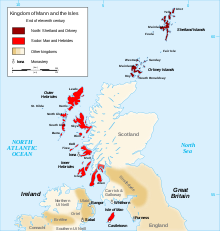
Viking raids began on Scottish shores towards the end of the 8th century, and the Hebrides came under Norse command and settlement during the ensuing decades, particularly following the success of Harald Fairhair at the Battle of Hafrsfjord in 872.[98] [99] In the Western Isles Ketill Flatnose may have been the dominant effigy of the mid 9th century, by which time he had clustered a substantial island realm and made a variety of alliances with other Norse leaders. These princelings nominally owed fidelity to the Norwegian crown, although in do the latter'south command was fairly limited.[100] Norse control of the Hebrides was formalised in 1098 when Edgar of Scotland formally signed the islands over to Magnus 3 of Norway.[101] The Scottish credence of Magnus III as King of the Isles came afterward the Norwegian rex had conquered Orkney, the Hebrides and the Mann in a swift entrada earlier the same year, directed against the local Norwegian leaders of the various island little kingdoms. By capturing the islands Magnus imposed a more direct royal control, although at a toll. His skald Bjorn Cripplehand recorded that in Lewis "burn down played high in the sky" equally "flame spouted from the houses" and that in the Uists "the male monarch dyed his sword cerise in blood".[101] [Notation 5]
The Hebrides were now part of the Kingdom of the Isles, whose rulers were themselves vassals of the Kings of Norway. This situation lasted until the partitioning of the Western Isles in 1156, at which time the Outer Hebrides remained under Norwegian command while the Inner Hebrides broke out nether Somerled, the Norse-Gael kinsman of the Manx imperial house.[103]
Post-obit the ill-fated 1263 expedition of Haakon IV of Norway, the Outer Hebrides and the Isle of Human were yielded to the Kingdom of Scotland as a effect of the 1266 Treaty of Perth.[104] Although their contribution to the islands can yet be found in personal and identify names, the archaeological record of the Norse period is very express. The best known discover is the Lewis chessmen, which date from the mid twelfth century.[105]
Scottish control [edit]
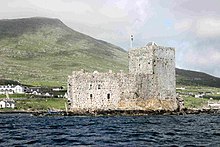
Every bit the Norse era drew to a close, the Norse-speaking princes were gradually replaced by Gaelic-speaking clan chiefs including the MacLeods of Lewis and Harris, Clan Donald and MacNeil of Barra.[106] [107] [Note half-dozen] This transition did petty to relieve the islands of internecine strife although by the early on 14th century the MacDonald Lords of the Isles, based on Islay, were in theory these chiefs' feudal superiors and managed to exert some control.[111]
The Lords of the Isles ruled the Inner Hebrides too as part of the Western Highlands as subjects of the King of Scots until John MacDonald, quaternary Lord of the Isles, squandered the family unit's powerful position. A rebellion by his nephew, Alexander of Lochalsh provoked an exasperated James Iv to forfeit the family's lands in 1493.[112]
In 1598, King James Half dozen authorised some "Gentleman Adventurers" from Fife to civilise the "nearly fell Island of Lewis".[113] Initially successful, the colonists were driven out by local forces commanded by Murdoch and Neil MacLeod, who based their forces on Bearasaigh in Loch Ròg . The colonists tried once more in 1605 with the aforementioned result, but a tertiary attempt in 1607 was more successful and in due course Stornoway became a Burgh of Barony.[113] [114] By this fourth dimension, Lewis was held past the Mackenzies of Kintail (later the Earls of Seaforth), who pursued a more enlightened approach, investing in fishing in particular. The Seaforths' royalist inclinations led to Lewis condign garrisoned during the Wars of the Iii Kingdoms by Cromwell'due south troops, who destroyed the old castle in Stornoway.[115]
Early British era [edit]
With the implementation of the Treaty of Union in 1707, the Hebrides became function of the new Kingdom of Bully United kingdom, only the clans' loyalties to a distant monarch were not stiff. A considerable number of islesmen "came out" in back up of the Jacobite Earl of Mar in the 1715 and again in the 1745 ascent including Macleod of Dunvegan and MacLea of Lismore.[117] [118] The aftermath of the decisive Battle of Culloden, which effectively concluded Jacobite hopes of a Stuart restoration, was widely felt.[119] The British government's strategy was to estrange the clan chiefs from their kinsmen and turn their descendants into English language-speaking landlords whose main concern was the revenues their estates brought rather than the welfare of those who lived on them.[120] This may accept brought peace to the islands, simply in the following century it came at a terrible price. In the wake of the rebellion, the association system was broken upward and islands of the Hebrides became a serial of landed estates.[120] [121]
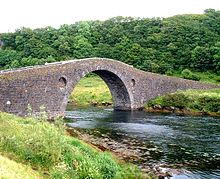
The early 19th century was a time of improvement and population growth. Roads and quays were congenital; the slate industry became a meaning employer on Easdale and surrounding islands; and the construction of the Crinan and Caledonian canals and other technology works such as Clachan Bridge improved transport and access.[122] However, in the mid-19th century, the inhabitants of many parts of the Hebrides were devastated by the Clearances, which destroyed communities throughout the Highlands and Islands as the homo populations were evicted and replaced with sheep farms.[123] The position was exacerbated by the failure of the islands' kelp industry that thrived from the 18th century until the end of the Napoleonic Wars in 1815[124] [125] and large scale emigration became endemic.[126]
As Iain Mac Fhearchair , a Gaelic poet from South Uist, wrote for his countrymen who were obliged to exit the Hebrides in the late 18th century, emigration was the only alternative to "sinking into slavery" as the Gaels had been unfairly dispossessed by rapacious landlords.[127] In the 1880s, the "Battle of the Braes" involved a demonstration confronting unfair land regulation and eviction, stimulating the calling of the Napier Committee. Disturbances continued until the passing of the 1886 Crofters' Act.[128]
Linguistic communication [edit]

Geographic distribution of Gaelic speakers in Scotland (2011)
The residents of the Hebrides have spoken a variety of different languages during the long period of human occupation.
Information technology is assumed that Pictish must in one case have predominated in the northern Inner Hebrides and Outer Hebrides.[97] [129] The Scottish Gaelic language arrived from Republic of ireland due to the growing influence of the kingdom of Dál Riata from the sixth century Advertising onwards, and became the dominant language of the southern Hebrides at that time.[130] [131] For a few centuries, the military might of the Gall-Ghàidheil meant that Old Norse was prevalent in the Hebrides. North of Ardnamurchan , the place names that existed prior to the ninth century have been all but obliterated.[131] The Old Norse name for the Hebrides during the Viking occupation was Suðreyjar , which means "Southern Isles"; in contrast to the Norðreyjar , or "Northern Isles" of Orkney and Shetland.[132]
South of Ardnamurchan , Gaelic place names are more mutual,[131] and after the 13th century, Gaelic became the chief linguistic communication of the entire Hebridean archipelago. Due to Scots and English being favoured in regime and the educational system, the Hebrides have been in a state of diglossia since at least the 17th century. The Highland Clearances of the 19th century accelerated the language shift away from Scottish Gaelic, as did increased migration and the continuing lower condition of Gaelic speakers.[133] Withal, as tardily every bit the finish of the 19th century, there were significant populations of monolingual Gaelic speakers, and the Hebrides nonetheless comprise the highest percentages of Gaelic speakers in Scotland. This is specially true of the Outer Hebrides, where a slim majority speak the linguistic communication.[133] [134] The Scottish Gaelic college, Sabhal Mòr Ostaig , is based on Skye and Islay.[135]
Ironically, given the condition of the Western Isles every bit the last Gaelic-speaking stronghold in Scotland, the Gaelic linguistic communication name for the islands – Innse Gall – means "isles of the foreigners"; from the time when they were under Norse colonisation.[136]
Modern economy [edit]

For those who remained, new economic opportunities emerged through the export of cattle, commercial angling and tourism.[137] Withal, emigration and armed forces service became the choice of many[138] and the archipelago'due south populations connected to dwindle throughout the belatedly 19th century and for much of the 20th century.[139] [140] Lengthy periods of continuous occupation notwithstanding, many of the smaller islands were abandoned.[141]
There were, however, standing gradual economical improvements, among the well-nigh visible of which was the replacement of the traditional thatched blackhouse with accommodation of a more modern design[142] and with the assistance of Highlands and Islands Enterprise many of the islands' populations have begun to increase subsequently decades of decline.[1] The discovery of substantial deposits of North Sea oil in 1965 and the renewables sector have contributed to a degree of economic stability in recent decades. For example, the Arnish yard has had a chequered history just has been a meaning employer in both the oil and renewables industries.[143]
The widespread immigration of mainlanders, particularly non-Gaelic speakers, has been a subject of controversy.[144] [145]
Agriculture practised by crofters remained pop in the 21st century in the Hebrides; crofters ain a small belongings only frequently share a big mutual grazing area. Diverse types of funding are bachelor to crofters to help supplement their incomes, including the "Basic Payment Scheme, the suckler beef support scheme, the upland sheep support scheme and the Less Favoured Expanse support scheme". One reliable source discussed the Crofting Agricultural Grant Scheme (CAGS) in March 2020:[146]
the scheme "pays up to £25,000 per claim in whatsoever two-year period, covering 80% of investment costs for those who are under 41 and accept had their croft less than five years. Older, more than established crofters can get threescore% grants".
Media and the arts [edit]
Music [edit]

Many contemporary Gaelic musicians accept roots in the Hebrides, including Julie Fowlis (Northward Uist),[147] Catherine-Ann MacPhee (Barra), Kathleen MacInnes (South Uist), and Ishbel MacAskill (Lewis). All of these singers take repertoire based on the Hebridean tradition, such as puirt à beul and òrain luaidh (waulking songs). This tradition includes many songs composed by picayune-known or anonymous poets before 1800, such as " Fear a' bhàta ", " Ailein duinn " and " Alasdair mhic Cholla Ghasda ". Several of Runrig's songs are inspired by the archipelago; Calum and Ruaraidh Dòmhnallach were raised on N Uist[148] and Donnie Munro on Skye.[149]
Literature [edit]
The Gaelic poet Alasdair mac Mhaighstir Alasdair spent much of his life in the Hebrides and oftentimes referred to them in his poesy, including in An Airce and Birlinn Chlann Raghnaill .[150] The best known Gaelic poet of her era, Màiri Mhòr nan Òran (Mary MacPherson, 1821–98), embodied the spirit of the land agitation of the 1870s and 1880s. This, and her powerful evocation of the Hebrides—she was from Skye—has made her among the almost indelible Gaelic poets.[151] Allan MacDonald (1859–1905), who spent his adult life on Eriskay and South Uist, equanimous hymns and poetry in honour of the Blessed Virgin, the Christ Child, and the Eucharist. In his secular poetry, MacDonald praised the dazzler of Eriskay and its people. In his verse drama, Parlamaid nan Cailleach (The Former Wives' Parliament), he lampooned the gossiping of his female parishioners and local marriage customs.[152]
In the 20th century, Murdo Macfarlane of Lewis wrote Cànan nan Gàidheal , a well-known poem about the Gaelic revival in the Outer Hebrides.[153] Sorley MacLean, the most respected 20th-century Gaelic writer, was born and raised on Raasay, where he set his best known poem, Hallaig , about the devastating upshot of the Highland Clearances.[154] Aonghas Phàdraig Caimbeul , raised on S Uist and described by MacLean as "one of the few really significant living poets in Scotland, writing in any language" (West Highland Gratuitous Printing, October 1992)[155] wrote the Scottish Gaelic-linguistic communication novel An Oidhche Mus practise Sheòl Sinn which was voted in the Top Ten of the 100 Best-Always Books from Scotland.
Moving-picture show [edit]
- The area around the Inaccessible Pinnacle of Sgurr Dearg of Skye provided the setting for the Scottish Gaelic feature movie Seachd: The Inaccessible Pinnacle (2006).[156] The script was written by the actor, novelist, and poet Aonghas Phàdraig Chaimbeul, who likewise starred in the movie.[155]
- An Drochaid , an hr-long documentary in Scottish Gaelic, was made for BBC Alba documenting the boxing to remove tolls from the Skye span.[157] [158]
Video Games [edit]
- The 2012 exploration chance game Honey Esther by developer The Chinese Room is set on an unnamed island in the Hebrides.
Influence on visitors [edit]
- J.M. Barrie's Marie Rose contains references to Harris inspired past a vacation visit to Amhuinnsuidhe Castle and he wrote a screenplay for the 1924 film adaptation of Peter Pan whilst on Eilean Shona .[159] [160] [161] [162]
- The Hebrides, also known as Fingal'southward Cave, is a famous overture composed by Felix Mendelssohn while residing on these islands, while Granville Bantock equanimous the Hebridean Symphony.
- Enya's song "Ebudæ" from Shepherd Moons is named after the Hebrides (meet beneath).[163]
- The 1973 British horror movie The Wicker Human is set up on the fictional Hebridean island of Summerisle.[164]
- The 2011 British romantic comedy The Decoy Helpmate is set on the fictional Hebrides isle of Hegg.[165]
Natural history [edit]
In some respects the Hebrides lack biodiversity in comparison to mainland U.k.; for case, there are simply half every bit many mammalian species.[166] Nonetheless, these islands provide breeding grounds for many of import seabird species including the earth'due south largest colony of northern gannets.[167] Avian life includes the corncrake, blood-red-throated diver, rock dove, kittiwake, tystie, Atlantic puffin, goldeneye, golden hawkeye and white-tailed bounding main eagle.[168] [169] The latter was re-introduced to Rùm in 1975 and has successfully spread to various neighbouring islands, including Mull.[170] There is a small population of red-billed chough concentrated on the islands of Islay and Colonsay.[171]
Cherry deer are common on the hills and the greyness seal and mutual seal are present around the coasts of Scotland. Colonies of seals are found on Oronsay and the Treshnish Isles.[172] [173] The rich freshwater streams incorporate brown trout, Atlantic salmon and water shrew.[174] [175] Offshore, minke whales, Killer whales, basking sharks, porpoises and dolphins are among the sealife that can be seen.[176] [177]
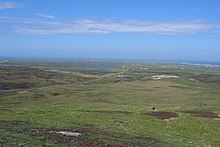
Heather moor containing ling, bell heather, cross-leaved heath, bog myrtle and fescues is abundant and at that place is a diversity of Arctic and tall plants including Alpine pearlwort and mossy cyphal.[178]
Loch Druidibeg on S Uist is a national nature reserve owned and managed by Scottish Natural Heritage. The reserve covers 1,677 hectares across the whole range of local habitats.[179] Over 200 species of flowering plants have been recorded on the reserve, some of which are nationally scarce.[180] South Uist is considered the best identify in the United kingdom for the aquatic plant slender naiad, which is a European Protected Species.[181] [182]
Hedgehogs are not native to the Outer Hebrides—they were introduced in the 1970s to reduce garden pests—and their spread poses a threat to the eggs of ground nesting wading birds. In 2003, Scottish Natural Heritage undertook culls of hedgehogs in the surface area although these were halted in 2007 due to protests. Trapped animals were relocated to the mainland.[183] [184]
Come across also [edit]
- List of islands of Scotland
- Scottish island names
- Geology of Scotland
- Timeline of prehistoric Scotland
- Fauna of Scotland
- New Hebrides
- Languages of Scotland
- Goidelic substrate hypothesis
- Insular Celtic languages
- Canadian Boat-Song
- The Lewis Awakening (Religious Revival)
References and footnotes [edit]
Notes [edit]
- ^ Rollinson (1997) states that the oldest rocks in Europe accept been found "nigh Gruinard Bay" on the Scottish mainland. Gillen (2003) p. 44 indicates the oldest rocks in Europe are found "in the Northwest Highlands and Outer Hebrides". McKirdy, Alan Gordon, John & Crofts, Roger (2007) State of Mountain and Flood: The Geology and Landforms of Scotland. Edinburgh. Birlinn. p. 93 state of the Lewisian gneiss bedrock of much of the Outer Hebrides that "these rocks are amid the oldest to exist constitute anywhere on the planet". Other (non-geologist) sources sometimes claim that the rocks of Lewis and Harris are "the oldest in United kingdom of great britain and northern ireland", meaning that they are the oldest deposits of large bedrock. As Rollinson makes clear, Lewis and Harris is not the location of the oldest small-scale outcrop.
- ^ Murray (1973) notes that "Western Isles" has tended to mean "Outer Hebrides" since the creation of the Na h-Eileanan an Iar or Western Isles parliamentary constituency in 1918. Murray likewise notes that "Gneiss Islands" – a reference to the underlying geology – is some other proper noun used to refer to the Outer Hebrides, only that its use is "confined to books".[7]
- ^ There are two inhabited islands chosen "Grimsay" or Griomasaigh that are joined to Benbecula by a road causeway, one to the north at grid reference NF855572 and one to the south eastward at filigree reference NF831473.
- ^ See above note.
- ^ Thompson (1968) provides a more than literal translation: "Fire played in the fig-trees of Liodhus; it mounted up to heaven. Far and broad the people were driven to flight. The fire gushed out of the houses".[102]
- ^ The transitional relationships between Norse and Gaelic-speaking rulers are complex. The Gall-Ghàidhels who dominated much of the Irish gaelic Bounding main region and western Scotland at this time were of joint Gaelic and Scandinavian origin. When Somerled wrested the southern Inner Hebrides from Godred the Black in 1156, this was the beginnings of a interruption with nominal Norse dominion in the Hebrides. Godred remained the ruler of Isle of mann and the Outer Hebrides, simply 2 years later Somerled'due south invasion of the former caused him to flee to Norway. Norse command was further weakened in the ensuring century, only the Hebrides were non formally ceded by Norway until 1266.[108] [109] The transitions from one language to some other are also complex. For example, many Scandinavian sources from this menstruum of time typically refer to individuals every bit having a Scandinavian get-go proper name and a Gaelic by-name.[110]
Citations [edit]
- ^ a b Full general Annals Office for Scotland (28 Nov 2003) Occasional Paper No 10: Statistics for Inhabited Islands. (pdf) Retrieved 22 January 2011. Archived 22 November 2011 at the Wayback Motorcar
- ^ Rollinson, Hugh (September 1997). "Great britain'southward oldest rocks" Geology Today. 13 no. 5 pp. 185-190.
- ^ Gillen, Con (2003). Geology and landscapes of Scotland. Harpenden. Terra Publishing. Pages 44 and 142.
- ^ Dawson, Alastrair Chiliad.; Dawson, Sue; Cooper, J. Andew G.; Gemmell, Alastair; Bates, Richard (2013). "A Pliocene historic period and origin for the strandflat of the Western Isles of Scotland: a speculative hypothesis". Geological Mag. 150 (two): 360–366. Bibcode:2013GeoM..150..360D. doi:10.1017/S0016756812000568. S2CID 130965005.
- ^ Keay & Keay (1994) p. 507.
- ^ Encyclopædia Britannica (1978) states: "Hebrides – group of islands of the due west coast of Scotland extending in an arc betwixt 55.35 and 58.thirty Northward and 5.26 and eight.twoscore W." These coordinates include Gigha, St Kilda and everything upward to Cape Wrath – although not North Rona.
- ^ Murray (1973) p. 32.
- ^ Thompson (1968) pp. 24–26.
- ^ Cakewalk, David J. "The ancient geography of Scotland" in Smith and Banks (2002) pp. 11-13.
- ^ Watson (1994) pp. 40–41
- ^ a b c d e Watson (1994) p. 38
- ^ Louis Deroy & Marianne Mulon (1992) Dictionnaire de noms de lieux , Paris: Le Robert, article "Hébrides".
- ^ a b Watson (1994) p. 37.
- ^ Watson (1994) p. 45.
- ^ a b c d e f k h Gammeltoft, Peder "Scandinavian Naming-Systems in the Hebrides - A Way of Understanding how the Scandinavians were in Contact with Gaels and Picts?" in Ballin Smith et al (2007) p. 487.
- ^ Woolf, Alex (2012) Ancient Kindred? Dál Riata and the Cruthin. Academia.edu. Retrieved 21 January 2015.
- ^ a b c Watson (1994) p. 85-86.
- ^ Mac an Tàilleir (2003) p. 80.
- ^ Haswell-Smith (2004) p. 262.
- ^ Thompson (1968) p. 13.
- ^ a b "The Roman Map of Britain Maiona (Erimon) vii Lougis Erimon Isles of Harris and Lewis, Outer Hebrides " Archived 27 November 2013 at the Wayback Motorcar romanmap.com. Retrieved 1 February 2011.
- ^ Megaw, J.V. S. and SIMPSON, D.A. (1960) "A short cist burial on North Uist and some notes on the prehistory of the Outer Isles in the second millennium BC" (pdf) p. 72 Proc Soc Antiq Scot. archaeologydataservice.ac.u.k.. Retrieved 13 February 2011.
- ^ a b c d east f g Haswell-Smith (2004) p. 236.
- ^ Mac an Tàilleir (2003) p. 17.
- ^ a b Mac an Tàilleir (2003) p. nineteen.
- ^ a b Mac an Tàilleir (2003) p. 46.
- ^ Mac an Tàilleir (2003) p. 50.
- ^ a b c d e f Haswell-Smith (2004) p. 218.
- ^ a b Mac an Tàilleir (2003).
- ^ Mac an Tàilleir (2003) p. 116.
- ^ Mac an Tàilleir (2003) p. 117.
- ^ Watson (1994) p. 93.
- ^ Gammeltoft (2010) pp. 482, 486.
- ^ a b c Haswell-Smith (2004) p. 143.
- ^ Haswell-Smith (2004) p. 118.
- ^ Mac an Tàilleir (2003) p. 31.
- ^ a b Haswell-Smith (2004) p. 52.
- ^ Mac an Tàilleir (2003) p. 38.
- ^ "Etymology of British place-names" Archived 9 September 2013 at the Wayback Machine www.pbenyon1.plus.com. Retrieved xiii Feb 2011.
- ^ a b c Haswell-Smith (2004) p. 76.
- ^ Watson (1994) p. 85.
- ^ Haswell-Smith (2004) p. 134.
- ^ a b c Mac an Tàilleir (2003) p. 105.
- ^ Watson (1994) p. 77.
- ^ Hákonar saga Hákonarsonar , § 328, line viii Retrieved 2 Feb 2011.
- ^ Mac an Tàilleir (2003) p. 72.
- ^ Haswell-Smith (2004) p. 32.
- ^ a b Gillies (1906) p. 129. "Gometra, from North., is gottr + madr + ey ."
- ^ Mac an Tàilleir (2003) pp. 58-59.
- ^ Haswell-Smith (2004) p. 185.
- ^ Watson (1926) p. 87.
- ^ a b Haswell-Smith (2004) p. 47.
- ^ a b Haswell-Smith (2004) p. 84.
- ^ Mac an Tàilleir (2003) p. 69.
- ^ Haswell-Smith (2004) p. 109.
- ^ a b Haswell-Smith (2004) p. seventy.
- ^ Mac an Tàilleir (2003) p. 83.
- ^ a b Haswell-Smith (2004) p. 65.
- ^ a b Haswell-Smith (2004) p. 132.
- ^ Mac an Tàilleir (2003) p. 93.
- ^ a b Haswell-Smith (2004) p. 161.
- ^ Mac an Tàilleir (2003) p. 102.
- ^ Haswell-Smith (2004) p. 138.
- ^ Haswell-Smith (2004) p. 153.
- ^ a b Mac an Tàilleir (2003) p. 103.
- ^ a b c Mac an Tàilleir (2003) p. 104.
- ^ Haswell-Smith (2004) p. 63.
- ^ "Grouping 34: islands in the Irish Sea and the Western Isles ane" kmatthews.org.uk. Retrieved ane March 2008.
- ^ Munro, D. (1818) Description of the Western Isles of Scotland called Hybrides, by Mr. Donald Munro, Loftier Dean of the Isles, who travelled through most of them in the year 1549. Miscellanea Scotica, 2. Quoted in Murray (1966) p. 146.
- ^ a b Haswell-Smith (2004) p. 195.
- ^ a b Haswell-Smith (2004) p. 102.
- ^ Buchanan (1983) Pages ii–6.
- ^ Haswell-Smith (2004) pp. 314–25.
- ^ Newton, Michael Steven. The Naughty Lilliputian Book of Gaelic: All the Scottish Gaelic You Demand to Expletive, Swear, Potable, Smoke and Fool around. Sydney, Nova Scotia: Cape Breton UP, 2014.
- ^ Watson (1994) p. 97.
- ^ Maclean (1977) folio 33.
- ^ Stevenson (1872) p. 10.
- ^ Mac an Tàilleir (2003) p. 111.
- ^ Haswell-Smith (2004) p 285.
- ^ Mac an Tàilleir (2003) p. 94.
- ^ Buxton (1995) p. 33.
- ^ Mac an Tàilleir (2003) p. 87
- ^ Murray (1973) p. 41.
- ^ Mac an Tàilleir (2003) p. 101.
- ^ Buxton (1995) p. 158.
- ^ Mac an Tàilleir (2003) p. 118.
- ^ Edwards, Kevin J. and Whittington, Graeme "Vegetation Change" in Edwards & Ralston (2003) p. 70.
- ^ Edwards, Kevin J., and Mithen, Steven (Feb. 1995) "The Colonization of the Hebridean Islands of Western Scotland: Evidence from the Palynological and Archaeological Records," World Archaeology. 26. No. 3. p. 348. Retrieved xx Apr 2008.
- ^ Li, Martin (2005) Take a chance Guide to Scotland. Hunter Publishing. p. 509.
- ^ "Mummification in Bronze Age Britain" BBC History. Retrieved eleven Feb 2008.
- ^ "The Prehistoric Village at Cladh Hallan". University of Sheffield. Retrieved 21 Feb 2008.
- ^ See for example Haycock, David Boyd. "Much Greater, Than Commonly Imagined." Archived 26 Feb 2009 at the Wayback Car The Newton Projection. Retrieved 14 March 2008.
- ^ Moffat, Alistair (2005) Before Scotland: The Story of Scotland Before History. London. Thames & Hudson. pp. 239-forty.
- ^ Nieke, Margaret R. "Secular Society from the Iron Historic period to Dál Riata and the Kingdom of Scots" in Omand (2006) p. 60.
- ^ Lynch (2007) pp. 161 162.
- ^ Clancy, Thomas Owen "Church institutions: early medieval" in Lynch (2001).
- ^ a b Hunter (2000) pp. 44, 49.
- ^ Hunter (2000) p. 74.
- ^ Rotary Club (1995) p. 12.
- ^ Hunter (2000) p. 78.
- ^ a b Hunter (2000) p. 102.
- ^ Thompson (1968) p. 39.
- ^ "The Kingdom of Mann and the Isles" thevikingworld.com Retrieved six July 2010.
- ^ Hunter (2000) pp. 109-111.
- ^ Thompson (1968) p. 37.
- ^ Thompson (1968) p. 39.
- ^ Rotary Lodge (1995) pp. 27, 30.
- ^ Gregory (1881) pp. thirteen-15, 20-21.
- ^ Downham (2007) pp. 174-75.
- ^ Gammeltoft, Peder "Scandinavian Naming-Systems in the Hebrides: A Way of Understanding how the Scandinavians were in Contact with Gaels and Picts?" in Ballin Smith et al (2007) p. 480.
- ^ Hunter (2000) pp. 127, 166.
- ^ Oram, Richard "The Lordship of the Isles: 1336–1545" in Omand (2006) pp. 135–38.
- ^ a b Rotary Club (1995) pp. 12-13.
- ^ Haswell-Smith (2004) p. 312.
- ^ Thompson (1968) pp. 41-42.
- ^ Murray (1977) p. 121.
- ^ "Dunvegan" Archived 4 June 2013 at the Wayback Machine castlescotland.net Retrieved 17 January 2011.
- ^ "Incidents of the Jacobite Risings - Donald Livingstone" Archived 16 July 2011 at the Wayback Machine clanmclea.co.united kingdom of great britain and northern ireland. Retrieved 17 January 2011.
- ^ "The Boxing of Culloden" BBC. Retrieved 16 January 2011.
- ^ a b Hunter (2000) pp. 195–96, 204–06.
- ^ Hunter (2000) pp. 207–08.
- ^ Duncan, P. J. "The Industries of Argyll: Tradition and Comeback" in Omand (2006) pp. 152-53.
- ^ Hunter (2000) p. 212.
- ^ Hunter (2000) pp. 247, 262.
- ^ Duncan, P. J. "The Industries of Argyll: Tradition and Improvement" in Omand (2006) pp. 157–58.
- ^ Hunter (2000) p. 280.
- ^ Newton, Michael. "Highland Clearances Function 3". The Virtual Gael. Archived from the original on 29 December 2016. Retrieved 7 January 2017.
- ^ Hunter (2000) pp. 308-23.
- ^ Watson (1994) p. 65.
- ^ Armit, Ian "The Iron Historic period" in Omand (2006) p. 57.
- ^ a b c Woolf, Alex "The Age of the Bounding main-Kings: 900-1300" in Omand (2006) p. 95.
- ^ Brown, James (1892) "Place-names of Scotland" p. four ebooksread.com. Retrieved 13 Feb 2011.
- ^ a b Duwe, Kurt C. "Gàidhlig (Scottish Gaelic) Local Studies". Linguae Celticae.
- ^ Mac an Tàilleir, Iain (2004) "1901–2001 Gaelic in the Demography" (PowerPoint) Linguae Celticae. Retrieved 1 June 2008.
- ^ "A' Cholaiste" . UHI. Retrieved 30 May 2011.
- ^ Hunter (2000) p. 104.
- ^ Hunter (2000) p. 292.
- ^ Hunter (2000) p. 343.
- ^ Duncan, P. J. "The Industries of Argyll: Tradition and Improvement" in Omand (2006) p. 169.
- ^ Haswell-Smith (2004) pp. 47, 87.
- ^ Haswell-Smith (2004) pp. 57, 99.
- ^ "Blackhouses" Archived 19 Jan 2010 at the Wayback Machine. isle-of-lewis.com Retrieved 17 January 2011.
- ^ "Yard wins biggest wind tower job". BBC News Online. 10 Dec 2007. Retrieved 6 January 2011.
- ^ McEwan-Fujita, Emily (2010), "Ideology, Affect, and Socialization in Linguistic communication Shift and Revitalization: The Experiences of Adults Learning Gaelic in the Western Isles of Scotland", Language in Society, 39 (ane): 27–64, doi:x.1017/S0047404509990649, JSTOR 20622703, S2CID 145694600
- ^ Charles Jedrej; Mark Nuttall (1996). White Settlers: Touch/Cultural. p. 117. ISBN9781134368501 . Retrieved 25 January 2017.
- ^ "How pocket-size crofters in the Hebrides survive the challenges".
- ^ "Julie Fowlis". Thistle and Shamrock. NPR. 22 May 2013. Retrieved 10 June 2013.
- ^ Hebrides at IMDb. Retrieved 15 Apr 2017.
- ^ "Donnie Munro: Biography" Archived 30 May 2014 at the Wayback Machine donniemunro.co.uk. Retrieved 5 April 2007.
- ^ John Lorne Campbell, "Canna: The Story of a Hebridean Island," Oxford University Press, 1984, pages 104–105.
- ^ J. MacDonald, "Gaelic literature" in Thousand. Lynch, ed., The Oxford Companion to Scottish History (Oxford: Oxford Academy Press, 2001), ISBN 0-19-211696-7, pp. 255-7.
- ^ School of Scottish Studies. (1967) Academy of Edinburgh. xi-12 p. 109.
- ^ "Làrach nam Bàrd". BBC Alba.
- ^ MacLean, Sorley (1954) Hallaig. Gairm magazine. Translation by Seamus Heaney (2002). Guardian.co.u.k.. Retrieved 27 May 2011.
- ^ a b "Angus Peter Campbell | Aonghas Phadraig Caimbeul - Fiosrachadh/Biog". Angus Peter Campbell. Archived from the original on 2 January 2017. Retrieved 15 April 2017.
- ^ Seachd: The Inaccessible Pinnacle (2007) at IMDb
- ^ "An Drochaid / The Span Rise". Media Co-op. Jan 2013. Archived from the original on two Feb 2017. Retrieved 25 January 2017.
- ^ "An Drochaid". BBC Alba. Retrieved 25 Jan 2017.
- ^ "Famous Visitors to the Islands - Luchd-tadhail Ainmeil " Archived 17 October 2002 at the Wayback Machine Civilization Hebrides. Retrieved 26 July 2008.
- ^ Thomson, Gordon (28 May 2009) "The firm where Big Brother was born" New Statesman. Retrieved 11 July 2011.
- ^ Assuming, Alan (29 December 1983) The Making of Orwell's 1984 The Glasgow Herald.
- ^ Haswell-Smith (2004) p. 130.
- ^ "Translations for Shepherd Moons". pathname.com. Retrieved twenty May 2011.
- ^ "The various versions of The Wicker Homo". Steve Philips. Retrieved 18 June 2013.
- ^ The Decoy Bride at IMDb
- ^ Murray (1973) p. 72.
- ^ "Seabirds" Archived iii June 2013 at the Wayback Machine. National Trust for Scotland. Retrieved 20 July 2013.
- ^ Fraser Darling (1969) p. 79.
- ^ "Trotternish Wildlife" Archived 29 Oct 2013 at the Wayback Machine Duntulm Castle. Retrieved 25 October 2009.
- ^ Watson, Jeremy (12 Oct 2006). "Ocean eagle spreads its wings...". Scotland on Sunday. Edinburgh.
- ^ Benvie (2004) p. 118.
- ^ "Protected mammals - Seals" Archived 20 September 2017 at the Wayback Car. Scottish Natural Heritage. Retrieved 6 March 2011.
- ^ Murray (1973) pp. 96-98.
- ^ Fraser Darling (1969) p. 286.
- ^ "Trout Angling in Scotland: Skye" trout-salmon-angling.com. Retrieved 29 March 2008.
- ^ "Trends - The Ocean" (PDF). Scottish Natural Heritage. Archived from the original (PDF) on 25 February 2012. Retrieved ane January 2007.
- ^ "Species List" Archived 2 June 2018 at the Wayback Machine. www.whalewatchingtrips.co.u.k.. Retrieved 28 December 2010.
- ^ Slack, Alf "Flora" in Slesser (1970) pp. 45-58.
- ^ "Loch Druidibeg National Nature Reserve: Where Opposites Meet". Archived 3 March 2016 at the Wayback Machine (pdf) SNH. Retrieved 29 July 2007.
- ^ "South Uist and Eriskay attractions" Archived 14 Jan 2015 at the Wayback Machine isle-of-south-uist.co.uk. Retrieved v July 2010.
- ^ "Higher constitute species: 1833 Slender naiad" JNCC. Retrieved 29 July 2007.
- ^ "Statutory Instrument 1994 No. 2716 " Archived eighteen May 2009 at the Wayback Machine Role of Public Sector Information. Retrieved 5 July 2010.
- ^ "Campaign to stop the slaughter of over 5000 Hedgehogs on the Island of Uist". Epping Wood Hedgehog Rescue. Archived from the original on 27 August 2006. Retrieved 1 Jan 2007.
- ^ Ross, John (21 February 2007). "Hedgehogs saved from the syringe every bit controversial Uist cull called off". The Scotsman. Edinburgh.
General references [edit]
- Ballin Smith, B. and Banks, I. (eds) (2002) In the Shadow of the Brochs, the Iron Age in Scotland. Stroud. Tempus. ISBN 0-7524-2517-X
- Ballin Smith, Beverley; Taylor, Simon; and Williams, Gareth (2007) West over Sea: Studies in Scandinavian Body of water-Borne Expansion and Settlement Before 1300. Leiden. Brill.
- Benvie, Neil (2004) Scotland'south Wildlife. London. Aurum Press. ISBN 1-85410-978-2
- Buchanan, Margaret (1983) St Kilda: a Photographic Anthology. W. Blackwood. ISBN 0-85158-162-five
- Buxton, Ben. (1995) Mingulay: An Island and Its People. Edinburgh. Birlinn. ISBN 1-874744-24-6
- Downham, Clare "England and the Irish-Body of water Zone in the Eleventh Century" in Gillingham, John (ed) (2004) Anglo-Norman Studies XXVI: Proceedings of the Boxing Conference 2003. Woodbridge. Boydell Printing. ISBN one-84383-072-8
- Fraser Darling, Frank; Boyd, J. Morton (1969). The Highlands and Islands. The New Naturalist. London: Collins. First published in 1947 under title: Natural history in the Highlands & Islands; by F. Fraser Darling. First published under the nowadays championship 1964.
- Gammeltoft, Peder (2010) "Shetland and Orkney Isle-Names – A Dynamic Group". Northern Lights, Northern Words. Selected Papers from the FRLSU Briefing, Kirkwall 2009, edited by Robert McColl Millar.
- "Occasional Paper No 10: Statistics for Inhabited Islands". (28 November 2003) General Register Office for Scotland. Edinburgh. Retrieved 22 January 2011.
- Gillies, Hugh Cameron (1906) The Place Names of Argyll. London. David Nutt.
- Gregory, Donald (1881) The History of the Western Highlands and Isles of Scotland 1493–1625. Edinburgh. Birlinn. 2008 reprint - originally published by Thomas D. Morrison. ISBN one-904607-57-8
- Haswell-Smith, Hamish (2004). The Scottish Islands. Edinburgh: Canongate. ISBN978-ane-84195-454-7.
- Hunter, James (2000) Last of the Gratuitous: A History of the Highlands and Islands of Scotland. Edinburgh. Mainstream. ISBN 1-84018-376-four
- Keay, J. & Keay, J. (1994) Collins Encyclopaedia of Scotland. London. HarperCollins.
- Lynch, Michael (ed) (2007) Oxford Companion to Scottish History. Oxford Academy Printing. ISBN 978-0-19-923482-0.
- Mac an Tàilleir, Iain (2003) Ainmean-àite/Placenames. (pdf) Pàrlamaid na h-Alba. Retrieved 26 Baronial 2012.
- Maclean, Charles (1977) Island on the Edge of the Earth: the Story of St. Kilda. Edinburgh. Canongate ISBN 0-903937-41-7
- Monro, Sir Donald (1549) A Description Of The Western Isles of Scotland. Appin Regiment/Appin Historical Society. Retrieved three March 2007. Starting time published in 1774.
- Murray, W. H. (1966) The Hebrides. London. Heinemann.
- Murray, W.H. (1973) The Islands of Western Scotland. London. Eyre Methuen. ISBN 0-413-30380-2
- Omand, Donald (ed.) (2006) The Argyll Volume. Edinburgh. Birlinn. ISBN 1-84158-480-0
- Ordnance Survey (2009) "Get-a-map". Retrieved 1–fifteen August 2009.
- Rotary Club of Stornoway (1995) The Outer Hebrides Handbook and Guide. Machynlleth. Kittiwake. ISBN 0-9511003-5-1
- Slesser, Malcolm (1970) The Island of Skye. Edinburgh. Scottish Mountaineering Club.
- Steel, Tom (1988) The Life and Death of St. Kilda. London. Fontana. ISBN 0-00-637340-two
- Stevenson, Robert Louis (1995) The New Lighthouse on the Dhu Heartach Rock, Argyllshire. California. Silverado Museum. Based on an 1872 manuscript and edited by Swearingen, R.G.
- Thompson, Francis (1968) Harris and Lewis, Outer Hebrides. Newton Abbot. David & Charles. ISBN 0-7153-4260-6
- Watson, W. J. (1994) The Celtic Place-Names of Scotland. Edinburgh. Birlinn. ISBN one-84158-323-five. Commencement published 1926.
- Woolf, Alex (2007). From Pictland to Alba, 789–1070. The New Edinburgh History of Scotland. Edinburgh: Edinburgh Academy Press. ISBN978-0-7486-1234-v.
External links [edit]
 | Wikivoyage has a travel guide for Hebrides . |
 | Wikimedia Eatables has media related to Hebrides. |
- Hebrides/Western Isles Guide
- National Library of Scotland: SCOTTISH SCREEN Archive (selection of archive films about the Hebrides)
- . Encyclopædia Britannica (11th ed.). 1911.
Coordinates: 57°50′N vii°00′W / 57.833°N 7.000°W / 57.833; -vii.000
DOWNLOAD HERE
Posted by: annaplacque.blogspot.com

Post a Comment for "The Wolf Of Kisimul Castle Free Download UPDATED"